
Leadership Ingredients
Same values, different expressions

As I stepped back from the interviews, it became clear that while similar leadership ingredients kept appearing, they rarely showed up in the same way. Resilience took different forms. Empathy showed up in varied ways. Attention to detail reflected each leader’s priorities.
Two leaders might both value empathy, but one shows it through close relationships and conversation, while another expresses it through fairness, consistency, and protection of standards. The ingredient is the same, the expression is different.
This distinction matters. When we confuse behavioural style with underlying values or attributes, we risk misreading or labelling people. What looks like a lack of empathy may simply be a different way of expressing it.
That contrast is easy to see when you look at leaders such as Carlo Ancelotti and Jürgen Klopp. Klopp’s leadership is visibly energetic and emotionally expressive, often using his own energy as fuel for the group. Ancelotti, by contrast, has long been associated with calmness and composure. As Ancelotti put it himself:
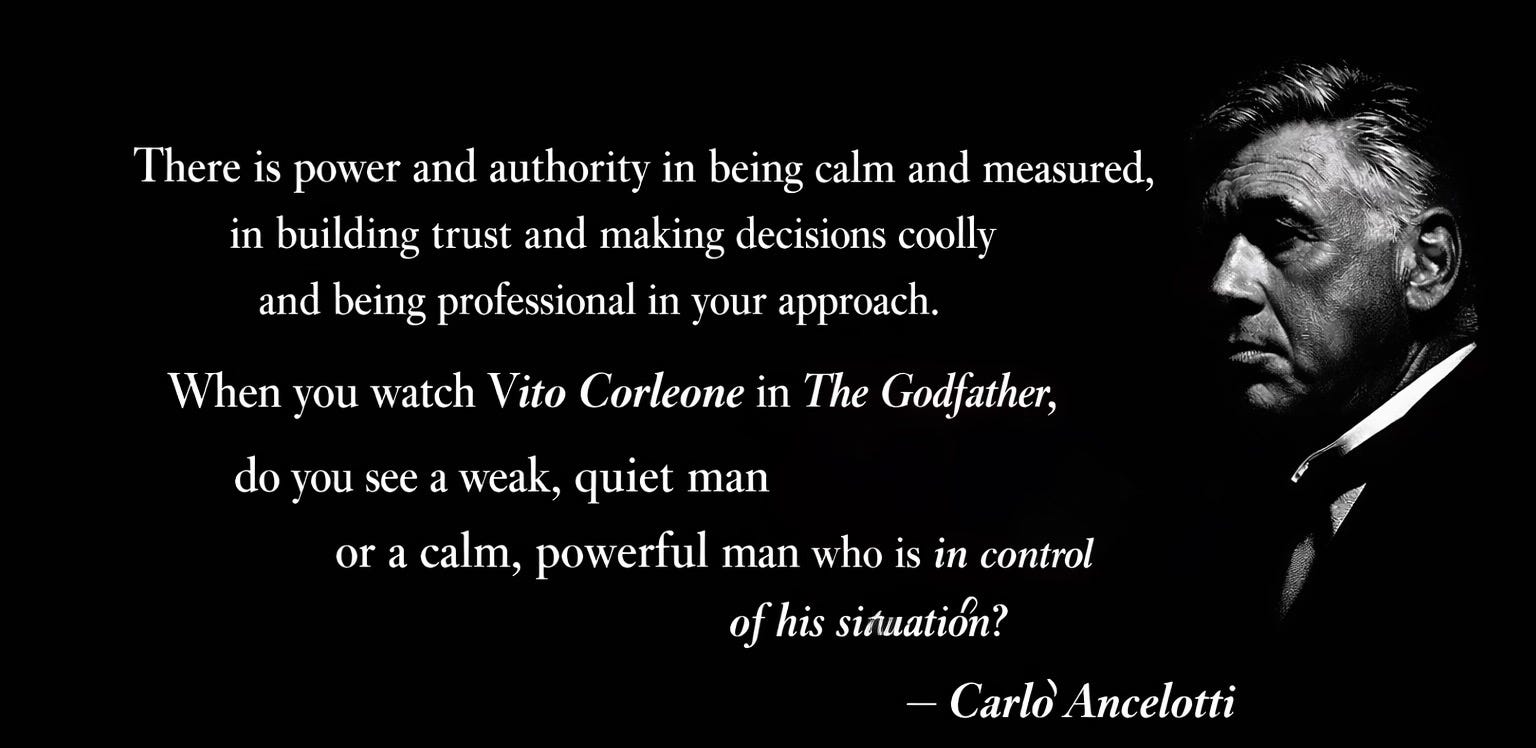
Both approaches have been effective at the highest level. Both place a strong emphasis on trust and people. The difference lies not in the ingredients, but in how those ingredients are expressed.
Going further, this idea was echoed by Stuart Lancaster, who challenged the assumption that effective leadership must always be charismatic:
“There are charismatic leaders who are great orators who can inspire and motivate but I would say they are actually quite rare. And if they are very good at that, they are usually not as good at other things, empathy and understanding of other people… ultimately, when it comes down to the day-to-day, week-to-week leadership qualities that people need, I think that style is limited in the long run.”
Since my interviews, I think there is now a greater acceptance that leadership can be done in so many ways, with charismatic leadership being one expression rather than the benchmark.
Detail, Control, and Care
As responsibility grows, leaders are often told they must let go. Yet for some, attention to detail is not about control, it is about care.
For Michael Maguire, being across the organisation is not about micromanagement, but about understanding the system he is responsible for leading:
“I tend to put myself across all parts of an organisation. So, I know exactly what the CEO is doing, what the administration department, the marketing department are doing… whilst I am not making decisions in those areas, I am very aware of what goes on in those departments because I utilise those in driving our whole organisation forward.”
By contrast, Sean Dyche described a more selective approach, one shaped by experience and trust in others:
“It is more a case of dipping your toe in and knowing enough to understand and push and pull where needed but not too much so you dominate. You have got to allow the people to work, allow the departments to work.”

Focus as a Leadership Skill
At the highest levels, leadership demands the ability to shift focus without losing intensity. In the NFL, where size and scale make total oversight impossible, this becomes a skill in its own right.
When I sit down with Dan Quinn at the Falcons’ Flowery Branch training facility in Atlanta, it is immediately clear that his time is tightly managed. Sarah Hogan, Quinn’s co-ordinator of head coach operations, runs his schedule to the minute. Our interview window is narrow. I push my luck and squeeze in an extra ten minutes, then leave Hogan with further questions for Quinn to reflect on and respond to later.


The logistics behind an NFL organisation are staggering. Around ninety players attend pre-season training camp, before the squad is cut to a 53-man roster for the season. The structure is highly delineated, and delegation is not optional, it is essential. Quinn’s staff alone includes more than twenty technical coaches, from assistant head coach and coordinators to position-specific specialists. That is before accounting for administration, medical, performance, equipment, scouting, and analysis departments.
Speaking about Quinn, his colleague described it like this:
“The thing he does better than anyone else I have been around is focus, then shift focus and re-establish focus. If he is having a conversation with you, you get 100 per cent of his attention… and it is the ability to do that for the entire day.”
Quinn’s own interjection, half-joking, hints at the cost and discipline behind that ability:
“Or I have ADD.”
Empathy After Experience
Empathy often deepens once leaders have been through setbacks of their own.
For Maguire, his reputation for toughness sits alongside a strong awareness of the emotional reality of professional sport:
“I completely understand the emotional ride that players go through… not everyone is a natural, not everyone is a superstar… you have to be across so many different personalities, and the personality of your team is key when you bring everyone together.”

Having performed at the highest level in his sport, Gary Kirsten understands the pressure of performance and the importance of tailoring communication to the people you work with:
“I understand when people are really battling in that space and I have an empathy towards that. I don’t believe in a one-size-fits-all approach. I would never come and impart a philosophy on a group of people and it just be that those who fit in fit in and those who don’t, don’t. It is not my style; I am trying to get the best out of people in whatever way I can intervene around their individual set of circumstances.”
Resilience, Empathy, and Detail
Across these leaders, the ingredients are remarkably consistent. Resilience, empathy, attention to detail, and focus keep resurfacing. What varies is how those qualities are expressed once leaders are in role, under pressure, and accountable for others. There is no single template to follow, only a need to understand what you value and how that shows up day to day.

If you have 5 minutes, spend some time reflecting on the questions below and how this all applies to you:
Reflection Questions - Grab a Brew
How might others misread your empathy based on how you show up as a leader?
Where does your focus get spread too thin, and where do you need to be more deliberate?
As responsibility has increased, what have you held on to that still serves the role, and what might you need to let go of?
Next Week
Next week, we will pause to reflect on the main leadership lessons from the opening section of The Making of a Leader.
Thanks for reading - and for being part of this space.
If there’s a question, challenge or idea you’d like me to explore in future posts, just hit the button below and let me know
Have a great week ahead
Tom