
Leadership lessons from Section 2: Approaches
Before we move on...

If this series has resonated so far, I’d really appreciate you sharing it with someone who cares about leadership, in sport or beyond.
Section Two of The Making of a Leader isn’t about theory or leadership frameworks. It examines what leaders learn once the role begins to expose them, when decisions carry consequences and certainty becomes harder to find.
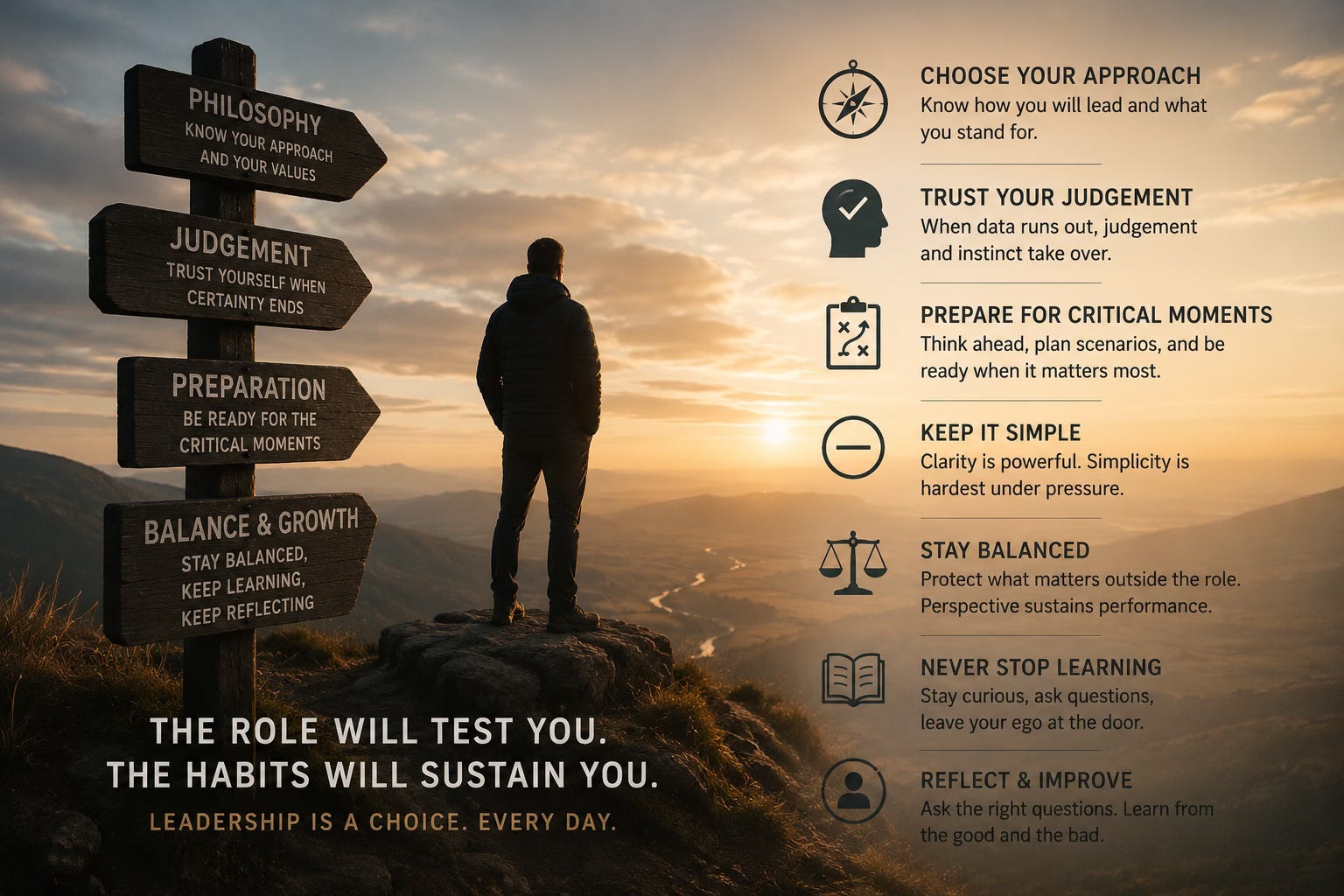
Leadership Lessons
Don’t be put off by the term ‘philosophy’ – ask yourself, ‘How am I going to do this?’ and, ‘What do I stand for?’ Stay true to your answers when making the big decisions.
There will be times when data and analysis cannot provide the answer. Back your judgement and trust your gut.
Sometimes progress is more important than perfection.
Prepare for the critical moments. Scenario planning allows you to react appropriately when the moment arrives.
Simple is not always easy. Keeping it so is often the hardest thing to do when under pressure.
A sense of balance is key. What are the most important areas of your life? Never lose sight of them; you will need them during the tough times.
Never stop learning within and beyond your fi eld. Be vulnerable and open enough to develop. Ask the questions, listen, observe. Leave your ego at the door.
Ask yourself the right questions. Reflection helps you learn from the good times, and the bad. Both will make you stronger
A Letter to the Reader
If you’re still reading at this point, you probably recognise yourself in some of this.
Not in the headlines or the job title, but in the quieter parts. The moments where decisions linger longer than you’d like. The nights when switching off isn’t as easy as it’s meant to be.
Most people talk about leadership as if it’s a position you arrive at. In reality, it’s something you carry. What I’ve tried to do in this section isn’t motivate you or offer clever frameworks. It’s simply to describe leadership as it tends to be lived, not how it’s often sold.
The leaders I’ve spent time with, across sport and business, aren’t immune to doubt, pressure, or loneliness. They’re just more honest about it. They know what they stand for, they accept the cost of their choices, and they keep finding ways to stay fit for the job rather than pretending it doesn’t take anything from them.
If this section has helped you pause, reflect, or feel a little less alone in the role, then it’s done its job.
Setting up Section 3
Section 2 has focused on the internal demands of leadership, how leaders think, decide, cope, and live with the consequences of their approach.
Section 3 shifts the lens outward.
Leadership doesn’t happen in isolation. In the next section, the focus moves to creating high-performance environments. Not slogans or values on the wall, but the conditions that shape behaviour day after day. How trust is built or eroded, how pressure is shared, how clarity, standards, and psychological safety combine to allow people to perform when it really counts.
If Section 2 was about staying fit to lead, Section 3 is about building environments that allow others to thrive.
And that’s where leadership becomes more than a personal challenge.

Spend some time reflecting on the questions below and how this section applies to you:
Reflection Questions
When a difficult decision lands on your desk, what principles guide how you respond?
Where in your leadership might progress be more valuable right now than waiting for the perfect answer?
What habits help you stay clear, balanced, and learning when the pressures of leadership begin to build?
Thanks for reading, and for being part of this space.
If this series has resonated, I’d really appreciate you sharing it with someone who cares about leadership, in sport or beyond.
If there’s a question, challenge or idea you’d like me to explore in future posts, just hit reply and let me know.
Have a great week.
Tom
Have a great week!
Tom