
The Inner Compass
The Role of Personal Values

Organisations talk a lot about values. Some live them daily. Others reduce them to slogans on the walls that fade into the background.
If you are part of a team, or leading one, values matter long before they are written down. They lie in how decisions are made, how people are treated, and what gets tolerated when things become uncomfortable.

A leader’s personal values do not need to mirror the organisation’s word for word, but they do need to align. When they don’t, people feel it quickly.
In reality, values are rarely neat and tidy. When someone can recite theirs perfectly, it might be too good to be true. Real values tend to show up less in what people say and more in what they do. What emerged from my conversations was something quieter and more revealing. Values were rarely announced. They were exposed through decisions, trade-offs, and reflection in key moments.
By this stage in the series, we have seen how upbringing, family, and teaching shape early leadership instincts. They also shape our values, the internal reference points leaders return to when there is no script, no consensus, and no guarantee of approval.
Doing What You Say You Will Do
During his time as England head coach, Stuart Lancaster was widely known for the emphasis he placed on values and standards. When asked about his own values, his answer was simple:
“I would say that I am honest, hard-working and authentic so what you see is what you get, and I have got good integrity and good moral values. I do what I say I am going to do.”
Later in our conversation, Stuart reflected on the role his own own beliefs and values play when making high-profile decisions:
“When I get faced with a decision about what direction to take, I often fall back to what I believe, what is my personal philosophy, where do I stand? And I am constantly checking and self-checking where I sit on one position or another.”
Values are not a fixed statement you refer back to when convenient. They are something you return to repeatedly, especially when the decision carries consequence.
Honest Communication
Sean Dyche reflected on his values and also what he felt was a misconception about him, that “Dyche just talks all the time”.
“I listen a lot more than people think. I don’t know about how effectively I deliver it but, in my internal thinking, I am always honest, and I try to be respectful. I try to guide players rather than just tell them all the time, I try to be open-minded, I try to have open discussions, open lines of communication. I think I am a reasonable communicator. I think I know the balance between seriousness and laughter. It’s a fine line but it’s an important line.”
Service, Sincerity, and the Military Influence
Dan Quinn’s values are heavily shaped by his connection to the military. It is not an aesthetic or a slogan. It is a way of viewing leadership as service. He regularly involves Navy SEAL training in training camps and it is a profession he may have entered into, had he not built a career in team sport.
“I have always wanted to be part of a team. The military have done ‘team’ better than anybody has, so I have a good connection to the military and my regard and respect for them is really high.”
Those values show up most clearly in how he treats people. His offensive co-ordinator at the time, Steve Sarkisian, described it simply:
“He is sincere and he is genuine, so all the messaging gets through to people because they know it comes from a truthful place.”
Sincerity is an underrated value in leadership. People can tolerate tough decisions if they believe the intent is real. When leaders are perceived as inauthentic, even the right decisions land badly.


Family, Belonging, and Responsibility
For 2025 NRL winner Michael Maguire, values are inseparable from family and togetherness, a theme we have already touched on earlier in the series.
“I am big on family. That is what a club is about, a sense of family. You have your good times and tough times, but you are going through it together. The tighter that becomes, the stronger the bond and the more you are willing to do for each other.”
This is not sentimentality. For Maguire, family implies standards, accountability, and shared responsibility. When leaders frame teams this way, they are not softening expectations. They are raising them.
There is also an important nuance here. The idea of a team as a ‘family’ is not without challenge. In many environments, ‘community’ may be a more accurate word. A place where people share values, feel valued as human beings, and understand their responsibility to one another. (A club can sell a star player, but you can’t sell your family)
Faith, Perspective, and Detachment from Reward
Gary Kirsten found values difficult to articulate, despite how clearly they guided his decisions.
“From a values perspective, people often ask me, ‘What has been your mantra or reasons for success?’. It is always a difficult thing to answer. I think every one of us has a trait, or characteristic or an attitude that helps us through, helps us manage the direction that we move into.”
For Kirsten, values were not something he felt the need to label. They were lived, revisited, and shaped over time. A central pillar of that process became his faith, first encountered as a young boy at Rondebosch Boys’ Prep School, then temporarily stepped away from during his playing career, before returning to with greater clarity later in life.
The night before his marathon innings at Kingsmead, where he went on to score 275, a conversation and prayer with his wife Deborah reaffirmed that faith. It remains central to how he views leadership, not as a position of authority, but as a responsibility to offer something to others.

Gary spoke openly about the role Deborah played in shaping his values beyond sport:
“Meeting my wife guided me in a direction to understand my life outside of sport. She gave me some good direction in terms of my values system as a human being. She played a strong mentoring role in that space.”
That sense of perspective also shaped his relationship with reward. When Kirsten turned the conversation to the commercial side of elite sport, his stance was clear:
“The money for me is a by-product of what you can do. I am not driven by the money. In fact, I have negotiated one or two of my contracts down, where I think I am being paid too much. I understand where my values sit financially.”
Values, in this sense, provide distance. They create separation from short-term reward and external validation. That distance allows leaders to make decisions that might look strange in the moment, but prove sustainable over time
Authenticity and the Weight of Decisions
Ashley Giles connects one of his core values, authenticity, to the reality of making difficult decisions:
“It is about being true to yourself. If I can wake up in the morning or go home at night and look in the mirror. I have to hire and fire people, that is not a nice position to be in…so you have to do it right.”
Leadership brings moments that do not sit comfortably. There are days when the decision is necessary but unwelcome. In those moments, values do not remove the weight of responsibility, but they can make it bearable. Knowing your actions align with what you stand for matters when there is no good outcome.
Giles also offers an important caveat. Authenticity, he suggests, is not the same as complete transparency:
“You do have to be authentic, but sometimes you put on a show because there will be situations when you are paddling like hell under the water but you can’t show it to the players – ‘oh we’re cool, we’re fine, don’t worry about it’ – and that can be quite wearing as well.”
There are times when protecting the group comes before a leader’s personal preference for openness. Shielding the team from uncertainty allows people to focus on their role and performance. Authenticity, in this sense, is not about sharing everything. It is about acting in service of those you lead.

Authenticity is a term we can sometimes hide behind. I have seen people justify their behaviour with phrases like “that’s just me being me” or “that’s just who I am”. In those moments, authenticity becomes a shield rather than a standard.
There is an important difference between being authentic and being unwilling to flex. The best leaders I have seen stay true to their values, but adapt how those values are expressed depending on the situation and the people in front of them.
Respect as a Baseline
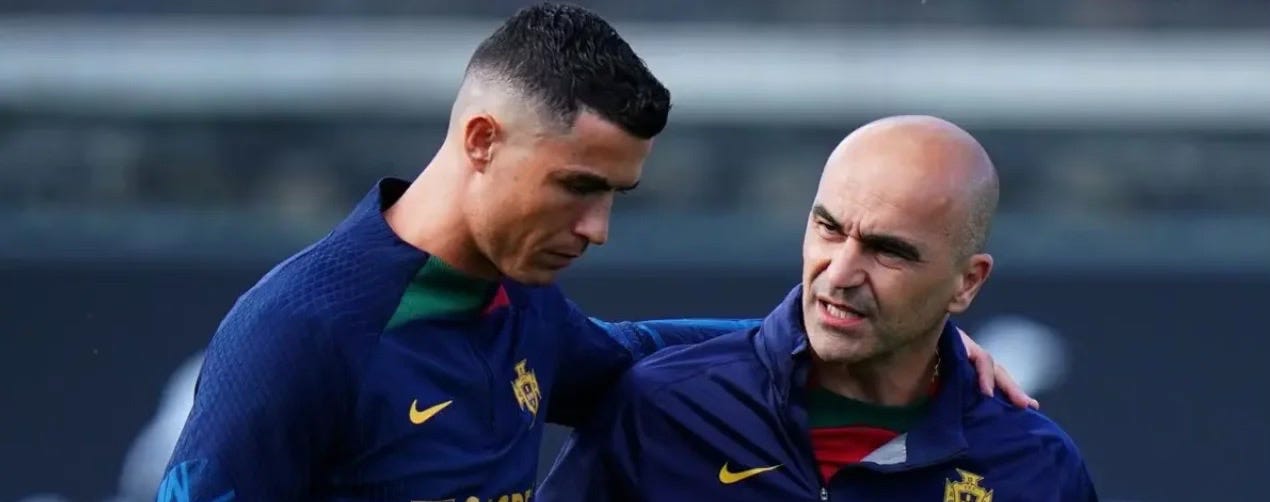
Roberto Martínez framed his values around dignity and respect:
“I would not expect people to embarrass people in front of others. I never want to let anyone down and that can be from a professional or a human point of view.”
That approach becomes even more important when working with high-profile individuals, where ego, scrutiny, and expectation are amplified. Managing someone like Cristiano Ronaldo is not about special treatment, but about understanding the human being behind the profile.
In environments increasingly driven by data, metrics, and efficiency, this matters. Leaders are not managing machines. They are working with people, often under intense pressure and visibility. How leaders handle those relationships in small, everyday moments quietly sets the tone for trust, accountability, and performance across the whole group.
Across all of these conversations, the same words kept resurfacing. Honest. Genuine. Respectful. Authentic. Not as slogans, but as standards leaders tried to live by, particularly when it would have been easier not to.
Values do not remove pressure or guarantee success. What they provide is an internal compass when the noise rises and the options narrow. They shape what leaders tolerate, what they protect, and what they are willing to walk away from.
Leadership will always involve difficult decisions. When those decisions are rooted in clear personal values, grounded in respect and sincerity, even the most disappointed athlete or colleague is more likely to accept the outcome, if not immediately, then over time

If you have 5 minutes, spend some time reflecting on the questions below and how this all applies to you:
Reflection Questions
What values guide your decisions when there is no clear or popular answer?
What would change in your leadership this week if you took your values more seriously?
When was the last time you acted against your stated values, and what did you tell yourself in that moment?
Next Week
Next week we look at formative adversity, the early setbacks and struggles that quietly build the resilience leaders later rely on when the spotlight arrives.
Thanks for reading - and for being part of this space.
If there’s a question, challenge or idea you’d like me to explore in future posts, just hit the button below and let me know
Have a great weekend!
Tom
Happy New Year!