
When Leadership Models Fail
What Leaders Default to When Theory Runs Out

We have more leadership content than ever.
Podcasts, books, and models…leadership has become something we analyse endlessly (guilty!). That isn’t a bad thing. It shows intent and curiosity, but it also creates a quiet illusion; that leadership can be understood in a neat and tidy way.
Most leadership models work best after the fact. They can explain leadership in hindsight, once the decision has been made, the pressure has passed, or the outcome is known.
They are far less helpful in the moment when time is short and the consequences sit squarely with you. That is usually where leadership actually happens.
Why Leadership Theories Keep Pulling You In
Early leadership theory focused heavily on traits, the idea that effective leaders possess certain characteristics that set them apart. In its simplest form, leaders were born, not made.
That thinking has been challenged repeatedly, but it never really disappears. It just evolves.

Where previous debates focused on authority, dominance, and charisma, modern language talks about authenticity, empathy, trust, and emotional intelligence. The terms change, but the underlying question remains the same: what makes someone effective when others look to them?
The issue is context.
No trait, no style, or model works everywhere. Leadership shifts depending on pressure, people, timing, and expectation. The moment context changes, theory can start to wobble.
Authenticity Sounds Simple, Until It Isn’t
More recent thinking has leaned heavily into authenticity, purpose, values, and self-awareness. The idea that leaders should be true to themselves feels intuitively right.
However, “be authentic” is not enough.
Leadership doesn’t happen in a vacuum. Being true to yourself still has to meet the needs of the environment and the people you’re responsible for. Sometimes the most authentic thing a leader can do is change a behaviour that once worked but now holds others back.
Authenticity without adaptation can quickly become self-indulgence and rigidity.
Transactional, Transformational, and the Tension Within
Another familiar distinction is between transactional and transformational leadership.
Transactional leadership focuses on structure, clarity, reward, and consequence. Transformational leadership focuses on relationships, inspiration, and shared purpose.
In reality, most leaders move between the two constantly.
Even the most values-driven leaders still need to set standards, make tough calls, and hold people accountable. Even the most direct leaders still need trust and connection to function.
Models help us describe these tensions. They don’t resolve them.
The Newer Models Get Closer
More recent leadership thinking has tried to grapple with complexity more honestly.
Adaptive leadership recognises that not all problems can be solved with technical answers. Some challenges require people to shift beliefs, thoughts, behaviours.
Servant leadership shifts the emphasis again, towards humility, care, and putting others first. It resonates because many leaders genuinely want to serve the people they lead.
Yet under pressure, service can slide into avoidance. There are moments when leadership means disappointing people you care about, enforcing standards, or taking authority back. Those moments sit uneasily inside the language of service.
Then there’s psychological safety, now central to most leadership conversations. The evidence is strong. Teams perform better when people feel safe to speak up, challenge, and admit mistakes.
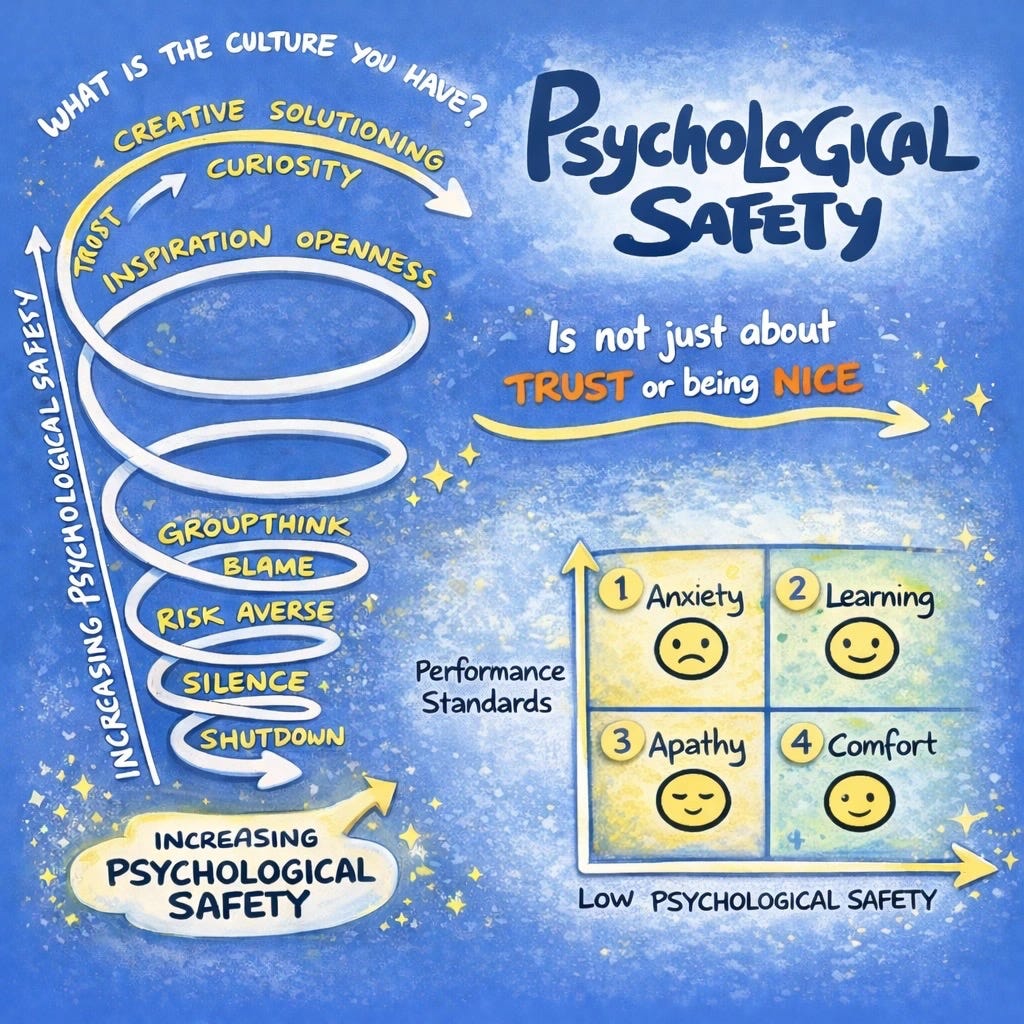
Yet safety alone doesn’t create performance. Leaders still have to apply pressure, demand standards, and make calls that unsettle people. Psychological safety explains the conditions for good work, not how leaders tolerate the discomfort of enforcing them.
All of these models move leadership thinking closer to reality. They acknowledge uncertainty, emotion, and relationships in ways earlier theories didn’t.
They also share the same limitation - they still struggle to capture what it feels like from the inside.
Consider the Lioness’ Head Coach, Sarina Wiegman.
She’s rarely framed through a leadership model, and she doesn’t talk in grand terms about philosophy or style. What stands out instead is what she defaults to when the pressure rises. Calm communication. Clear roles. Understanding the people. Trust in preparation. Directness without drama.
In finals, penalty shootouts, and moments of intense scrutiny, her leadership doesn’t look theoretical. It looks consistent. And that consistency isn’t coming from a framework. It’s coming from habits, standards, and decisions she’s prepared to stand by.
You see a similar pattern with Emma Hayes.
Across her time at Chelsea, her leadership evolved with the environment, the squad, and the demands of the league. She’s spoken openly about changing how she communicates, how much she controls, and when she steps back. Not because a model demanded it, but because the context did.
What’s consistent isn’t a style or a framework, but a willingness to adapt without losing clarity or standards. Again, the leadership isn’t theoretical. It’s visible in decisions, behaviour, and what she’s prepared to own when things don’t land.


Gareth Southgate and the Limits of Safety
Few leaders in sport have shifted culture as visibly as Gareth Southgate. Southgate rebuilt England around connection and psychological safety.
Players spoke openly. Young leaders were trusted. Mistakes were absorbed rather than punished. For a national team long associated with tension, that cultural shift mattered.
But tournament football eventually strips culture down to decision-making. Finals. Penalties. Game management. Substitutions. Risk.
In those moments, psychological safety can’t make the decision for you.
It doesn’t tell you whether to stay patient or chase the game. Whether to protect loyalty or introduce change. Whether to absorb criticism or stay steady in your approach.
Safety creates the environment. It does not remove exposure.
Southgate’s leadership has come to be known for connection, culture and breaking down barriers (penalties, anyone?). You can describe it through different models, but what stands out is consistency. When the pressure rises, he defaults to habits and standards he has already decided he can live with.
That is where leadership moves beyond theory and becomes personal.
What Actually Drives Behaviour Under Pressure
When pressure arrives, leaders aren’t choosing between models. They’re choosing what the moment demands of them.
To hold their nerve or retreat
To protect relationships or standards
To absorb criticism or pass it on
To adapt or double down
Those choices aren’t made by theory. They’re made by habit, identity, and tolerance for risk.
That’s why leadership models tend to help most after the moment has passed. They help leaders reflect, learn, and make sense of what happened. They don’t always guide behaviour when the clock is ticking.
Before talking about philosophy, identity, balance, or coping, it’s worth being honest about this.
Models matter. They sharpen reflection and provide common language. Yet when pressure hits, something else takes over.
What leaders default to, what they stand for, and what they can live with when the outcome is uncertain.

If you have 5 minutes, spend some time reflecting on the questions below and how this all applies to you:
Reflection Questions
When the pressure is real, what actually shapes your decisions?
Which leadership ideas or frameworks do you reach for when things feel uncertain, and what might they be shielding you from having to own?
If leadership models disappeared tomorrow, what would people experience from you when things get difficult?
Next Week
In the next piece, I want to move from models to something people often refer to as philosophy.
Not as a polished statement or something you sit down and formally write. In reality, leaders often overcomplicate it. For many, it’s just a shorthand for how they try to do the job, what they prioritise, and what they’re prepared to live with.
Some leaders rarely talk in grand terms. Sean Dyche physically recoiled at the word. Michael Carrick, in recent weeks, has done the same. They keep it simple. Standards. Honesty. Clarity. Doing the basics well. Nothing ornate. Nothing theoretical.
And yet, when pressure arrives, you can see exactly what they default to.
That’s what the next piece is really about. Not philosophy as an idea, but philosophy as the thing you fall back on.
Thanks for reading - and for being part of this space.
If there’s a question, challenge or idea you’d like me to explore in future posts, just hit the button below and let me know
Have a great week!
Tom